
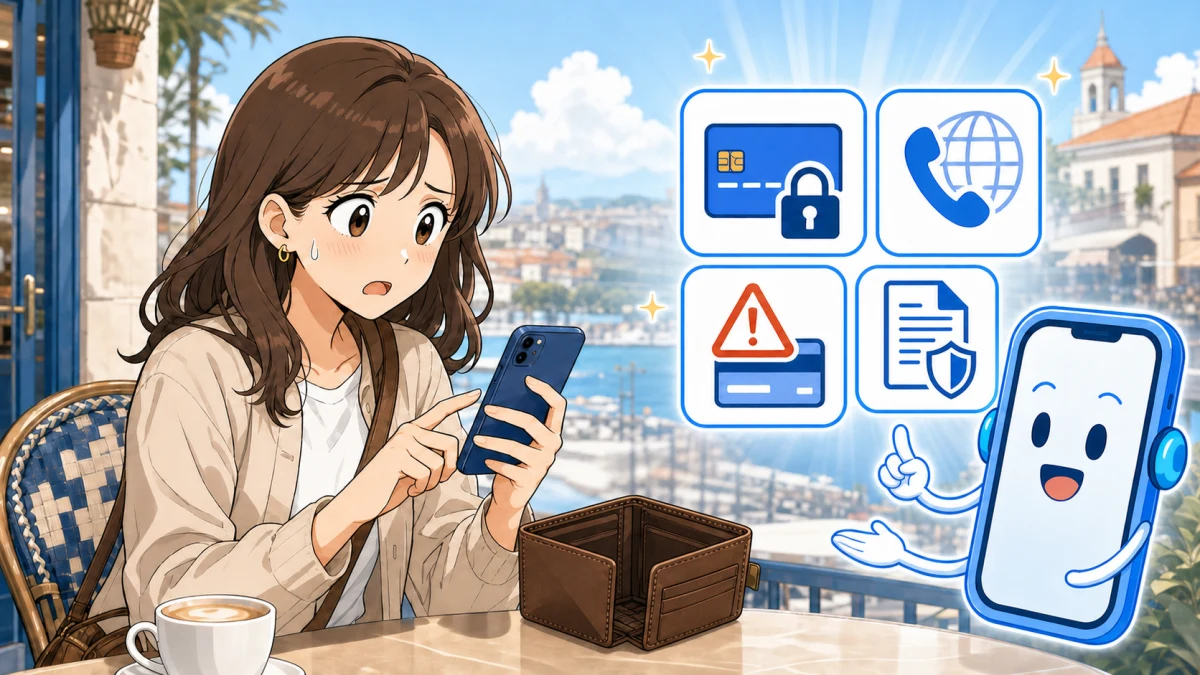
 🆘 Worried about trouble abroad? Travel AI Rescue helps you on the spot — theft, illness, a lost passport, scams & more. See how it works →
 Checked against the Tokyo Metropolitan Police Department’s official English-language pages on 5 September 2026. Bank contact details and liability terms vary by issuer, so confirm your own card’s emergency number before you travel.
Japan still runs on a mix of cash and cards, and it’s easy to hand a card over a dozen times a day — at a konbini register, a ticket machine, a restaurant tablet. Most of the time nothing goes wrong. But if you check your statement and see a charge you don’t recognize, the instinct for a lot of travelers is to head straight for the nearest police box. That’s not actually the first move, and getting the order wrong costs time you don’t have.
Calling the police first doesn’t stop the charges
A police report records what happened. It doesn’t cancel your card, and Japanese police have no way to freeze a payment card account — only your card issuer can do that. So the first call, before anything else, goes to the number on the back of your card or your bank’s own emergency line, asking them to block the card immediately. Every major network — Visa, Mastercard, JCB, and the rest — runs a 24-hour lost-and-stolen line specifically for this, reachable from overseas, and most accept collect calls if you can’t get through on a normal international line. You don’t need a working Japanese phone number to make this first call; you need the number that’s already printed on your card or in your bank’s app.
The police report still matters — just for a different reason
Once the card is blocked, filing a report with Japanese police is worth doing anyway, because it creates the kind of paper trail your card issuer or travel insurer may ask for when you dispute the charges later. The Tokyo Metropolitan Police Department’s own guidance for visitors is refreshingly simple here: for a lost item, theft, or anything that leaves you unsure what to do, “head to the nearest police box (koban).” Koban handle these reports directly, no appointment needed, and staff there deal with tourists regularly.
For a genuine emergency — the card is being used right now and you need help immediately — dial 110. For something that already happened and isn’t unfolding in real time, the non-emergency police consultation line #9110 is available with English support, which is usually the better fit for “my card was charged for something I never bought.”
Report it as theft, not as something you lost
If you still have the physical card in hand and it’s the card details that were compromised — skimmed, or leaked in an online purchase — say so plainly at the koban: this is fraud, not a lost-property case. Framing it correctly from the start means officers route it to the right process immediately, rather than treating it as an item you misplaced.
What to have ready before you call anyone
Two things speed up both calls: your card number (or at least the last four digits, if that’s all you can find) and a rough list of transactions you don’t recognize, with dates if your banking app shows them. Having this ready means the bank can start the block and the dispute process in the same call, instead of needing to call you back once you’ve dug it up.
How Travel AI Rescue helps
Travel AI Rescue keeps Japan’s emergency and non-emergency police lines one tap away, with the country code already attached, so you’re not searching for a number while you’re trying to remember which charges are real. It can display a Japanese-language card explaining exactly what happened — “my credit card was used without permission,” for instance — so koban staff understand you immediately even without a shared language. And above all, it helps put together a clear summary of the disputed charges and a report draft you can hand to your bank or insurer, while keeping your card details and issuer contact numbers stored and readable on the device even with no signal. It works differently from a staffed help desk, and it’s with you around the clock — a bridge that gets you to the right window with the right information already prepared. (Whether a charge is reversed is a decision made by your card issuer, not by Travel AI Rescue.)
Sources
- Tokyo Metropolitan Police Department, “For Visitors to Tokyo.” https://www.keishicho.metro.tokyo.lg.jp/multilingual/english/safe_society/victim_of_crime/ninpo.html (accessed 5 September 2026).
- Tokyo Metropolitan Police Department, “If you’ve lost something.” https://www.keishicho.metro.tokyo.lg.jp/multilingual/english/finding_services/lost_and_found/lost_something.html (accessed 5 September 2026).
🆘 Don't just read it — be ready for it.
Travel AI Rescue is an emergency travel AI for theft, illness, SIM trouble & more — auto-drafted police reports, local-language cards and an on-device valuables vault. Bundle it with your eSIM.
See how Travel AI Rescue works →