 🆘 Worried about trouble abroad? Travel AI Rescue helps you on the spot — theft, illness, a lost passport, scams & more. See how it works →
 Checked against official Japanese government pages on 2 September 2026. Exact self-pay pricing varies by hospital, since each institution sets its own rate for uninsured patients — the one thing worth confirming is your travel insurance’s coverage limit before you go, not after.
Calling for help in Japan doesn’t require guessing a number or working out which private insurance network to call first — it’s 119, the same digits nationwide, and the call itself is free no matter your nationality or insurance status. What catches visitors off guard isn’t the call. It’s what happens after: Japan’s national health insurance system, the one that keeps costs low for residents, doesn’t apply to tourists at all. Based on notices from Japan’s Ministry of Health, Labour and Welfare (MHLW) and the Japan Tourism Agency, here’s what actually happens, and what’s worth arranging before you land.
119 works in English, Chinese, Korean, Portuguese and Spanish
Every fire department in Japan is reachable at 119 for both ambulance and fire, and the call costs nothing. Tokyo Fire Department’s official page describes the system in detail: dispatch centers keep English-speaking staff on duty around the clock, and calls in other languages are routed through a three-way interpretation service covering English, Chinese, Korean, Portuguese, and Spanish. You don’t need to speak Japanese to be understood — you need to get through, and be ready to say where you are.
The ambulance ride itself is still free — for now
Unlike in the US or several European countries, dispatch and transport by ambulance in Japan currently carries no charge, funded instead through local tax revenue. A municipal fire department page (Owariasahi City, Aichi) puts it plainly: calling an ambulance costs no money, because the cost of running the ambulance service is covered by the taxes everyone pays. That’s the situation as of this writing, though Japan does have an ongoing national conversation about introducing partial fees for clearly non-urgent calls — a pattern similar to the debate around helicopter mountain-rescue fees already in place in some prefectures. For a genuine medical emergency today, the ambulance itself won’t bill you.
The hospital bill is where nationality actually matters
Here’s the part that surprises people. Japan’s National Health Insurance (国民健康保険), the system that covers residents at a fraction of the full cost, was built around residency status, not citizenship — an MHLW notice ties eligibility to residency, and tourists simply fall outside it. That means hospitals bill visitors at full self-pay rates (自由診療), a price each institution is free to set on its own. MHLW has gone as far as publishing a pricing manual specifically to help hospitals set consistent self-pay rates for inbound foreign patients — an acknowledgment that this gap exists and needs structure, not a promise that the price will be low.
They can’t turn you away for being a tourist
The one part of this that should be reassuring: refusal isn’t legal just because you’re foreign or uninsured. A 2019 MHLW notice on physicians’ duty to treat states the principle directly — the same standard for justifiably declining a patient applies to foreign patients as it does to Japanese ones, and facts specific to foreign patients, such as the theoretical option of getting treatment back home, don’t by themselves justify a refusal. In practice, if you’re having a genuine emergency, a hospital treating you is the expectation, not a courtesy.
This is a before-you-land problem, not an after-the-fact one
The Japan Tourism Agency’s own guidance for hospitals accepting foreign patients is blunt about why this matters: without insurance, medical costs can become extremely high, and travelers are advised to carry private travel insurance with sufficient coverage before the trip starts. Once you’re in an ambulance, the number you dial is the same regardless of insurance status — but the bill afterward is not, so the only real point of control is settling coverage before you leave home.
How Travel AI Rescue helps
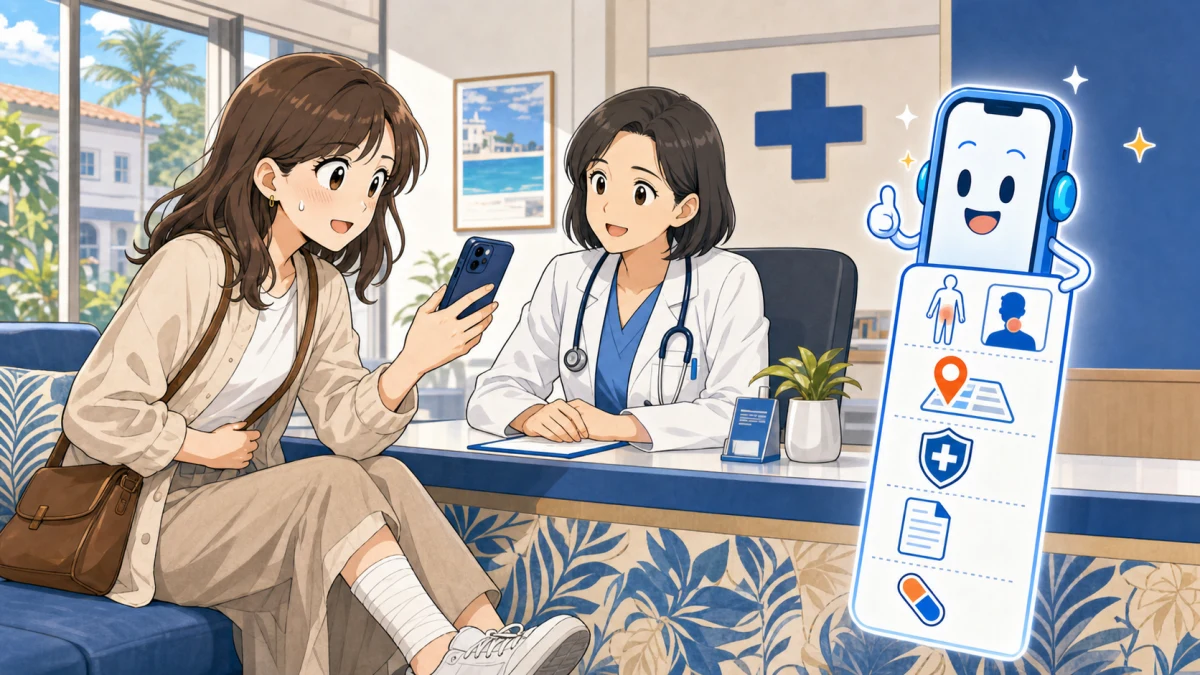
Travel AI Rescue keeps Japan’s emergency numbers — 119 for ambulance and fire, 110 for police — one tap away with the country code already attached, so you’re never digging for a number while something is actively going wrong. It can display Japanese-language cards describing your situation in plain terms, so hospital staff or bystanders understand you immediately even without a shared language. And above all, the AI drafts a clear summary of your symptoms and the sequence of events as you describe them — the kind of detail that speeds up both treatment and any insurance claim afterward. Your passport and travel insurance policy number stay stored and readable on the device even with zero signal, and there’s offline diagnosis for when the eSIM itself won’t connect. It works differently from a staffed help desk or the insurance policy itself, and it’s with you around the clock — a bridge that gets you to the right care quickly and in the right words. (Treatment itself, and what it costs, is determined by the hospital providing your care.)
Sources
- Tokyo Fire Department, “119番通報の多言語対応” (Multilingual support for 119 calls). https://www.tfd.metro.tokyo.lg.jp/lfe/119/119.html (accessed 2026-09-02).
- Owariasahi City Fire Department, “救急車を呼んでも、お金はかかりません” (Calling an ambulance costs no money). https://www.city.owariasahi.lg.jp/site/syoubou/2786.html (accessed 2026-09-02).
- Ministry of Health, Labour and Welfare, 保険発第41号, “外国人に対する国民健康保険の適用について” (Application of National Health Insurance to Foreign Nationals). https://www.mhlw.go.jp/web/t_doc?dataId=00ta3349&dataType=1&pageNo=1 (accessed 2026-09-02).
- Ministry of Health, Labour and Welfare, “訪日外国人の診療価格算定方法マニュアル” (Pricing Manual for Treating Inbound Foreign Patients). https://www.mhlw.go.jp/stf/seisakunitsuite/bunya/kenkou_iryou/iryou/newpage_08838.html (accessed 2026-09-02).
- Ministry of Health, Labour and Welfare notice 医政発1225第4号 (2019-12-25), on the duty to respond to requests for medical treatment, mirrored by Yamanashi Prefecture. https://www.pref.yamanashi.jp/documents/1626/20191225ousyougimu.pdf (accessed 2026-09-02).
- Japan Tourism Agency (MLIT), guidance for hospitals accepting foreign patients. https://www.mlit.go.jp/kankocho/seisaku_seido/kihonkeikaku/inbound_kaifuku/ukeire/kankochi/kanja.html (accessed 2026-09-02).
🆘 Don't just read it — be ready for it.
Travel AI Rescue is an emergency travel AI for theft, illness, SIM trouble & more — auto-drafted police reports, local-language cards and an on-device valuables vault. Bundle it with your eSIM.
See how Travel AI Rescue works →